26 December 2008

At last, full-time job obtained by year end 2008


(Masthead of Taiwan Daily News, first issue, 6 May 1898)

At last, the project proposal I submitted is formally approved by the National Science Council, Taiwan – that is to say, I've just been offered a one year fixed term contract job.

The project intends to construct a database of articles and all the contents about music, including people, events, venues and objects, in Taiwan Daily News (臺灣日日新報 Taiwan ririxin bao), the longest continuously published newspaper from 1989 to 1944, almost the whole period of the Japanese rule over Taiwan. The database will provide valuable sources for studies on music history and any other musical subjects during the Japanese colonial period.

I will be working as a postdoctoral fellow at National Taiwan University in 2009, while teaching Musical Cultures Around the Globe there and another university, hosting radio programmes, composing for commercial films and so on to earn some more pocket money. Above all, with the materials collected and gleaned from Taiwan Daily News by project team members, I will also be able to examine the musical life of Taiwanese locals in the colonial era and carry out my own research.

Breathing a sigh of relief, Fanne is very much delighted to learn that I have eventually found a full-time job and one year's salary plus year-end bonus is guaranteed. Although Christmas is not a public holiday in Taiwan, and due to the economic downturn, it hardly feels Christmasy at all in Taipei, we just take this as one of the best Christmas gifts we've ever received.

06 December 2008

Flamenco and popcorns with hot fruit tea

flamencoI have been lecturing on Music Cultures Around the Globe since the spring semester 2008 at National Taiwan University and recently been involved in organising the Friday Noon Concert Series of the College of Liberal Art.With some financial support granted by the Center for General Education, I can invite guest speakers to the course several times each semester, which helps me to maintain close contact with some excellent artists and performers in Taipei. Therefore, as an extension of the course Music Cultures Around the Globe, those musicians are also invited to the Friday concerts.

Yesterday we had a wonderful time with four artists from the Centro Flamenco Taiwan. Students and staff of the university gathered at the spacious entrance hall of the College of Liberal Art to be enthralled by the astonishing power of flamenco.

It was probably the best of the series this semester, I dare say. May even took the day off and managed to come to the performance, and after the show we went to the cinema, starting our weekend half a day earlier than others.

What I want to write down here is nothing about the film itself, which is too bland, though not to the extent of a flop, to be mentioned, but rather the bizarre combination of snack and drink we had – popcorns, half-sweet-half-salt, with hot fruit tea.

I suppose people usually have popcorns with carbonated soft drinks. Nevertheless, we don't need extra CO2.

Despite the lackluster film and the odd food combination, we had a great early start of the weekend.

23 November 2008

European symphony vs. Andalusian muwashshah

Mozart

(Excerpt from 'Lamma Bada Yatathanna/ Symphony No. 40'. This 50-second clip is only intended as demonstration, not meant to infringe copyright.)

A couple of weeks ago I found Mozart In Egypt, a 1997 Virgin Classics album, created by the French musician Hughes De Courson, fusing Mozart's classical work and Arabic tradition in Egypt into an interesting auditory compound.

The album gained a mixed reception.

Contributing to Customer Review on amazon.com, a doctoral student in composition from Oxford University argues that Mozart In Egypt is just an exquisite example of the omnipresent postmodern phenomenon, that is, 'blurred realities and imposed mixtures of different cultural aesthetics'.

In this reviewer's opinion, De Courson's intention to marry Western functional tonality and diatonic harmonies with Arabic extemporaneous ornamentation and linear flows based on the maqam system represents 'mass-produced and degraded trivialisations of true artistic and cultural statements'.

Contrastingly, on the same Customer Review page, a linguistics professor from Université Paris Panthéon Sorbonne acclaims the album as 'sound-senstional' and commented that Mozart's music is successfully blended with Egyptian music. Traditional Arab instruments offer those from the western classical tradition a new depth, and through the voice of the Orient 'Mozart's music is regenerated and ressuscitated out of its classic texture and harmony.'

I don't really want to comment on, or review, what I have heard. After all, an experimental or fusion album of this kind tends to elicit criticism, in which deprecators condemn the oversimplification and dumbing down of two musical cultures, as well as invites praise, in which advocates applaud for the merge of two different worlds and new aural experience it generates.

What captivates me in this album is the third track, which neatly brings together Mozart's 'Symphony No. 40' and 'When She Begins To Sway' (لما بدا يتثنى Lamma bada yatathanna), an old famous Arab song from Moorish Spain.

Listen to the audio excerpt above and pay close attention to how a European symphony turns into an Andalusian Muwashshah. It's entertaining.

13 November 2008

'Man On The Flying Trapeze' vs. 'On The Swing'


(It Happened One Night, 1934)

Following the previous post on 'Build Up A Home', here comes another case: Li Jinhui's 'On The Swing' (鞦韆架上 Qiuqianjia shang) and the nineteenth-century popular song 'The Man On The Flying Trapeze'.

'The Man On The Flying Trapeze', also known as 'The Daring Young Man On The Flying Trapeze', is a song about a real figure, the French acrobat and flying trapeze performer Jules Léotard. It was composed by Gaston Lyle, with lyrics by the English music hall singer George Leybourne.

For some historical accounts of this song, please visit The Word on the Street from National Library of Scotland, by which an original copy of the broadsheet is collected. Click the picture on the right to read lyrics, or rather the story of Jules Léotard.

Now listen to the Chinese 'On The Trapeze' by Ying Yin (英茵), a singer-actress from the 1930s, and follow the lyrics if by any chance you read Chinese. I believe 'On The Swing' was obviously adapted from 'The Man On The Flying Trapeze'.


那快樂已過去剩了悲傷
這個紫薇兒才向夏天脫掉衣裳
我淚珠兒滴滿了大地海洋
你這害人的漂亮姑娘

當你還是位那麼個小小姑娘
我就對你把愛情兒講
早從沒有一絲兒得你原諒
我就為著那個少年情郎

他飄悠悠坐在那鞦韆架上
那眼珠兒引動了四方姑娘
你先別管誰麻煩後兒愛梳 (not sure about this line)
你用媚眼兒向他飛揚

我就為他徹把低一來一封
不過我愛情就別再講
這樣沒過了三五個白天晚上
他倆並坐在鞦韆架上

他飄在天堂X樂洋洋 (one character unintelligible)
那美少年站在了鞦韆架上
那漂亮亮姑娘們都來一旁
我的愛情也從此了帳

08 November 2008

'Build A Little Home' with Chinese lyrics


(Eddie Cantor, Roman Scandals, 1933)

Build A Little Home
Lyrics: Al Dubin
Music: Harry Warren

We'll always have a roof above us as long as there's a sky.
And if we have someone to love us, we're sure of getting by.
We don't need a lot of log and stone.
Build a home on happiness alone.

With a million little stars, we can decorate the ceiling
With an optimistic feeling when we build a little home.
Ev'ry single little dream is a shingle or a rafter.
We can paint the house with laughter when we build a little home.
It's not a palace nor a poor house, but the rent is absolutely free.
This is my house, but it's your house if you'll come and live with me.
With a carpet on the floor made of buttercups and clover,
All our troubles will be over when we build a little home.

*     *     *

Due to the word or page limit for the thesis, or the time limit for the presentation of the thesis, PhD students sometimes may have to edit out several sections, or even chapters, to observe the size restriction, or leave unsolved issues in abeyance in order to submit in time. However, sometimes they may wish they had discovered something and wrote it down in the theses.

I have been misled by old Shanghai songbooks and magazines for umpteen years to believe that the old Shanghai song 'A Little Family' (小小家庭 Xiaoxiao jiating) is an original tune composed by Li Jinhui (黎錦暉), the so-called progenitor of Chinese pop music in modern times.

Thanks to Davide, who showed me some recordings and their paper labels, I learnt that the lovely tune was actually adapted from an American song 'Build A Little Home' written by Harry Warren for the musical comedy Roman Scandals in 1933.

There are actually more cases in which American songs were claimed to be written by Li Jinhui, either mistakenly or intentionally, for example, Stephen Foster's 'Oh! Susanna' to be 'Don't Cry, Susan' (蘇三不要哭 Susan buyao ku) and Sammy Fain's 'By A Waterfall' to be 'Narcissus Girl' (水仙花小姐 Shuixianhua guniang).

It's a pity that I didn't find this out before the thesis was submitted, otherwise I could have added in my thesis one more section about how songwriters in 1930s Shanghai set Chinese lyrics to foreign tunes and claimed those pieces their own works in published songbooks.

Anyway, listen to a clip from 'A Little Family' in Chinese by a girl member, Zhang Jing (張靜), from Li Jinhui's dance-and-song troupe. It sounds cute. Readers who read Chinese may want to follow the lyrics below.


我們相愛且相親,我們時時刻刻歡欣,兩個人同一顆圓心,建設造起小家庭。
惟聞輕笑淺歌聲,只是柔情蜜愛殷殷,人世如同神仙勝境,這個小小好家庭。
誰願坐龍廷,積聚金銀,攬著巍巍威欺壓小民,壞了天真,昧了良心,那兒能比鴛鴦侶。
同歡共慶永相親,我們時時刻刻歡欣,兩個人同一顆圓心,堅固永遠小家庭。

29 October 2008

The mysterious mi between black and white keys

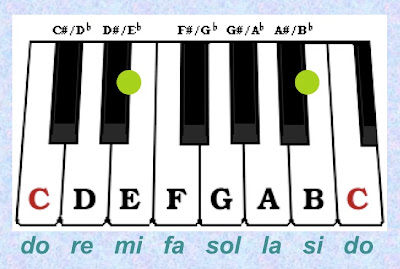
I gave a lecture on music of the Arab world yesterday, during which I pointed up one of the most important its musical characteristics to my students — the neutral third, i.e., the musical interval between a minor third and a major third. It's roughly a quarter tone flat from 12 equal temperament major thirds.

As the above explanation sounds like technobabble, for the benefit of those students who have no knowledge of Western music theory, I usually describe the neutral third as
the interval, or simply distance, between do and the mysterious tone which is located between the black mi and the white mi.
I also prepare on the PowerPoint slide a wee diagram of the piano keyboard and three sound clips so that students can 'see' and 'hear' clearly what I refer to.

Keyboard

This clip plays do-re-mi-fa-sol with mi on the white key.


This clip plays do-re-mi-fa-sol with mi on the black key.


This clip plays do-re-mi-fa-sol with mi, something between black and white keys that can't be produced on the Western piano.


The interval between do on the white key and this mysterious mi is the so-called neutral third. In music of the Arab world, one can also hear another similar tone between the black si and the white si, and thus the scale below.

Neutral2

This clip plays do-re-mi-fa-sol-la-si-do with the mysterious mi and si.


So, dear readers, do you recognise the sound characteristic of the neutral third?

13 October 2008

Happy anniversary, Francesca and David

Fanne and I had already left Scotland when Francesca and David were married in the Church of the Holy Rude in October last year. We were thus unable to attend the wedding and certainly missed her shining moment.

Although nowadays people can google a person whom they have lost touch with for a while through millions of web pages to find out the person's updates or whereabouts, unfortunately there appears to be no online wedding album of, nor weblog by, nor feature story on Francesca and David. I gathered no information about the couple's wedding in the cyber world.

I didn't contact her through email, either. Since the IT personnel of the University of Stirling had probably not only cut red tape but also eradicated it completely, they worked in such an efficient way that my campus email account was terminated immediately after the graduation, probably no later than one hour. Never been warned to back up all the mails and data stored in the university server by the graduation day, I lost all the mails Francesca sent me and therefore her email address.

Nevertheless, I might have been halfhearted and just didn't keep my mind on it, otherwise I could have retrieved Francesca's contact details through our mutual friends in Stirling. Luckily, I saw her on MSN Messenger a week or so ago and are now in contact. Fanne and I missed their big day, but we're in time to convey our hearty congratulatory message and post off a belated gift.

Since Francesca has been studying Chinese, in the end she will be able to decipher what these four-character idiomatic phrases mean, as well as the analogies therein.
琴瑟和鳴,笙磬同音。百年好合,白首偕老。
For other readers of Principal Wei's Weblog, below is the paraphrased English translation.
May
String sound on the zithers in harmony;
reeds voice towards jade bars* with euphony.
Nuptial bliss outlast hundreds of years;
steadfast couple amass silver in hairs.
*As I cannot find any Western equivalent of the ancient Chinese musical instrument qing (磬 or 罄 interchangeably), a series of chime stones or jade bars with definite pitches suspended from above to be struck, I simply use jade bars. Perhaps jade chimes would look more elegant, but I love the word bar.

11 October 2008

Guards and students KO'd by heat

Currently in different countries as they are, it can be assured that, if meeting together after reading my previous post, Prof Ricardo Canzio, Dr Inez Templeton and Miss Margaret Hendry would first shake their heads, probably at the same frequency, and then offer their comment in unison
Wei (or Chih-Wei as Canzio usually addresses), don't exaggerate!
Well, I didn't. It was true. It's baking, piping, scorching and whatever-ing hot yesterday. It was so hot that four honour guards and three girl students fainted at the three-hour long ceremony (Read this news article from The China Post for more details).

Although it was reported that they might not have got heatstroke, I do believe it was the heat that floored them. I didn't exaggerate.

10 October 2008

Double-Ten in tropical ambience

Today is the national day of the Republic of China, the so-called Double-Ten Day, commemorating the uprising in Wuchang on 10 October 1911, which led to the collapse of the corrupted Qing Dynasty and the establishment of the Republic of China.

As this Chinese Republic nowadays has only its sovereignty over Taiwan, the Pescadores (澎湖 Penghu), Kinmen (金門) and Matsu (馬祖), and the People's Republic of China has long been recognised by most countries in the world as the sole legitimate government of China, the double-ten celebration is no longer passionately observed by everyone across Taiwan, although we still have a day off today and official commemoration, fireworks and a range of events will be hold.

According to the Chinese lunisolar calendar, the autumnal equinox has already gone on 22 September and we've just passed the solar term hanlu (寒露, literally 'cold dew') on 8 October. It seems to be the time of year when falling leaves drift by the window and brisk winds knock on the door.

However, there isn't any cold dew. I can hardly feel any touch of autumn in the air, but instead the warm and relaxed tropical ambience. With its heat and brightness, the sun is still caressing the land, but, I'm afraid, not in a gentle way. It's 30 °C in Taipei at 2.00 p.m. While Inez is enjoying her favourite time of year in Berlin, most people in Taiwan are still having their dog days here.

Looking forward to the arrival of bleak winter and lukewarm about the national day of Republic of China as I am, I'm glad most tropical Homo sapiens in Taiwan will surely enjoy pyrotechnic displays on the warm land in the balmy zephyr at this double-ten night.

26 September 2008

Tango at lunch break


('Romance de Barrio' by Aníbal Troilo and his orchestra, singer: Floreal Ruiz)

I do not tango just as I do not dance at all. However, I listen to and sing tangos.

May and I attended Tango fever - Tango Argentina!!, a lunch concert organised by Taishin Bank Foundation for Arts and Culture (台新銀行文化藝術基金會), at Taishin Tower (台新金控大樓), the headquarters of Taishin Holdings (台新金控) in Taipei. The concert today was one of the regular Good Afternoon Music series.

The iTango Orchestra began with 'Por Una Cabeza' and finished up with 'La Cumparsita', probably the two essential pieces for any popular tango concert. The rest on the programme were:
  • four tangos: 'Derecho Viejo', 'Vida Mía', 'Danza Maligna', 'Libertango'
  • two milongas: 'La Luciérnaga', 'Corralera'
  • one vals: 'Romance de Barrio'
  • one tango canción, I guess, which I've never heard before: 'Claudinette'
Although it was a 'tango' concert, my favourite one today was 'Romance De Barrio', because it was the only vals they presented today. Somehow I believe I may have developed a liking for tango waltz although there are not many pieces of vlas in the whole tango repertoire.

The concert was a great success. All the seats were taken and if the floor hadn't been carpeted, some tango aficionados would have swayed around at the hall.

Perhaps one day I will ask Fanne to take tango lessons with me, because one day she would get bored with accompanying me on piano, and likewise I might be fed up with singing to her accompaniment all the time.