07 May 2007

Eurovision 2007 is coming

Eurovision
The Eurovision Song Contest, an annual competition held among active member countries of the European Broadcasting Union, is coming again! This year the semi-final and the final will be held on the 10th and the 12th of May respectively in Helsinki and telecast by Finland's national broadcasting company Yleisradio Oy.

The contest started in 1956 and has been telecast every year, but I only came to know it in 2001 when I first visit the British Isles. Although it has been transmitted far beyond European borders to North America and some countries in Mideast, Asia and Australasia, unfortunately it has never been shown in Taiwan.

There are 42 participating countries in the 2007 Contest. The so-called 'Big 4', which includes France, Germany, Spain and the UK, the four major financial contributors to the EBU, and the top 10 placed countries from the 2006 final will automatically qualify for this year's final. The other 28 countries will compete in the semi-final on the 10th of May for another 10 places to enter the final. Therefore, a total of 24 countries will be vying for the trophy on the 12th of May.

I suppose my European colleagues and friends will definitely know very well about the Contest but friends from other part of the world, for example my homeland Taiwan where Eurovision has never been broadcast, probably would be interested in how to decide who the winner is.

The winner of the Eurovision is determined by a voting system similar to the Borda count. Both in the semi-final and in the final each participating country will vote for their top 10 contestants, excluding themselves, by assigning 12 points to their favourite, 10 points to their second favourite and 8 down to 1 point to their third to tenth favourites. A country's set of votes is decided by the general public through televoting or SMS.

Interestingly, there is always criticism that Enrovision is just a political institution because the way a country assigns points basically depends on its political relationship to other countries rather than on the performance of the contestants. For example, Scandinavian countries tend to favour their neighbours and Greece and Cypress usually exchange 12 points with each other. Here is a paper from the Oxford University, titled How does Europe Make Its Mind Up? Connections, cliques, and compatibility between countries in the Eurovision Song Contest, which gives an analysis of voting patterns in the Contest.

Well, since I'm in the UK, I'll definitely watch the semi-final on BBC and the final on BBC One, just like how I would follow the Last Night of the Proms in September every year.

As my supervisor Simon comments that we can always see at the last night of the Proms how Britons are united by a musical event, I wonder if we can see at the final of Eurovision how Europeans would be joined together by a song contest.

01 May 2007

Mongolian singing and leather shoes

I have recently watch a film, The Cup (Phörpa), and therein heard a Mongolian song and learnt a Tibetan Buddhist lesson. While the song brought to my mind the moment I figured out how to sing like the Tuvan group Huun-Huur-Tu many years ago one morning in the toilet, the lesson reminded me of those days when I practised Tibetan Buddhism in Taiwan.

This film is based on true events in which two young Tibetan monks tried desperately and finally managed to fetch a television with a satellite dish into a remote Himalayan monastery to watch the 1998 FIFA World Cup final. It is directed by Khyentse Norbu (also known as Dzongsar Khyentse Rinpoche), a Bhutanese born Tibetan lama who was officially recognised as the third incarnation of the founder of Khyentse Lineage of Tibetan Buddhism. It is also the first-ever feature film that has been produced in Bhutan.

This film caught me from the very beginning when a piece of Mongolian overtone-singing (Hoomii) was played against the opening credits. I was quite surprised at the use of Mongolian Hoomii in a Tibetan film. Although overtone-singing can also be heard in some Tibetan Buddhist chanting, the timbre and technique are quite different from those in Hoomii.

In Mongolian Hoomii, a singer produces a constant pitched fundamental and simultaneously modulate the selected overtones, from the 4th harmonic till the 16th, to create a formantic melody. However, in Tibetan Buddhist chanting, for example, the prayers recited by monks at the Gyuto Tantric University, there is a much lower fundamental, as low as 70Hz, and more simultaneous notes, and the 10th harmonic is especially made louder than other overtones.

Anyway, it doesn't matter. The lively and delightful Mongolian song is definitely more suitable for the opening of this light-hearted film than a sonorous and solemn Buddhist prayer.

Apart from the Mongolian song at the opening and the hilarious plot developing throughout the film, I was engrossed by the teaching of the abbot of the monastery at the end of the film.

Just before the ending credits, the abbot Lama Chonjor, lectured to the young monks
Can we cover the earth with leather to make it soft and comfort to walk on? No. What about covering our feet in shoes? Yes. Covering our feet in shoes works as well as covering the earth with leather.

Likewise, just as space is limitless, so are enemies omnipresent. It is impossible to overcome all enemies, yet once one overcome hatred, he also practically overcome all the enemies, all the discontent in this world and all the fears and sufferings created by ego-consciousness.
...

If a problem can be solved, what's the reason to be unhappy? And if it cannot be solved, what's the use of being unhappy?
Simple as it is in principle, I would say it is difficult in practice. I'm not ready in properly fitted shoes and just can't cheer up when seeing problems unsolved. There is much more for me to be learnt and practised in all aspects of life.

24 April 2007

The original setting of 'Auld Lang Syne'

Everybody knows the famous Scottish tune to which Robert Burn's poem Auld Lang Syne is sung, probably far better than the words. I suppose it is Robbie's poem and the occasions on which we sing it, such as the midnight on Hogmanay as well as the end of a céilidh or the Last Night of the Proms, that make the melody prominent. In my homeland Taiwan, it is usually played in graduations and funerals as a token of farewell.

Actually, there has been some doubt whether the melody we sing today is exactly the one Burns originally wrote words for. Nevertheless, it is a traditional Scots song and surely predates his time. I once asked folks in my local, Port Customs Bar about its origin but no one could give me a clear idea. Several weeks ago through a Scottish fiddler, Stuart Badenoch, I came to know a tune which is claimed to be Burn's original setting for his words.

Listen to my demonstration of the tune with only the first verse and chorus.
Should auld acquaintance be forgot,
And never brought to mind?
Should auld acquaintance be forgot,
And auld lang syne?

For auld lang syne, my jo,
For auld lang syne,
We'll tak a cup o' kindness yet,
For Auld lang syne!
Well, this is just a home-made clip, if you would like to listen to a professionally produced recording of the complete five verses, check out the debut album The Winnowing of the Edinburgh-based duo The Cast, featuring Mairi Campbell (fiddler) and Dave Francis (guitarist).

19 April 2007

Can you insure a premature wedding?

I came across a new insurance product (not exactly new but new enough to me) online this afternoon after a heated verbal argument with my fiancée – wedding insurance, which safeguards your big-day investment with cancellation, postponement, legal expense, liability, natural disaster and so on coverage.

As explained on the web page, on your wedding day 'things can and do go wrong' and although 'wedding insurance can't guarantee that your special day will run smoothly', whatever happens, it give you peace of mind and helps financially. Clearly, the insurance covers financial losses and extra expenses for re-arrangement should any unexpected happens.

However, can you insure a wedding even if it is still under planning and may end prematurely?

I don't think there is any policy that pays if the wedding is cancelled and you break up with your fiancé(e) because of certain dispute over details of the ceremony or whether traditional customs should be followed. What's more, not until today did I realise how the process of planning a wedding may spoil a good relationship, lead to irremediable damage to both families, shatter hopes and cause huge power struggles.

Well, I'm not suggesting that my wedding plan is terminated. The Scottish wedding at the six-hundred-year-old Church of the Holy Rude, Stirling on the 23rd of June, a dream to my fiancée, will surely come true but the Taiwanese wedding to amuse family members and friends of both sides in Taiwan may be nixed due to a ridiculous rhubarb.

I was told the English will fight furiously on every single issue regarding a wedding for months before, right through or even after the great day and in the event both families may sue each other. However, I don't think the Taiwanese are any more rational although we don't usually bring the case before the court.

My parents would like to observe the tradition of choosing an auspicious date and hour for the wedding by consulting a Chinese astrologist who performs the analysis based on my and my fiancée's birth-dates and birth-hours. According to the astrologist my parents engaged, the auspicious hour is between 7 and 9am.

Obviously, the said auspicious hour is a wee bit early for a wedding ceremony, but my soon-to-be parents-in-law surprisingly can't be bothered to have a meeting with my parents to discuss details and find common ground.

Bloody heck, if my parents are so conservative and my fiancée's parents just don't even have the courtesy to be there vis-à-vis with my parent, I'll just have one wedding in Stirling and say 'off you go' to our parents.

13 April 2007

I collect thimbles and therefore I am a digitabulist

Thimbles
(Part of my thimble collection)

As mentioned in the previous entry, apart from admiring cherry blossoms, which are supposed to betoken the friendship between the US and Japan, and observing how the hotel-dimensioned White House is belittled in size by the grandiose Capitol, I bought some thimbles in Washington DC.

I came to know souvenir thimbles in 2001 when I visited Britain and had been collecting them ever since. Whereas others may buy spoons, key chains, plates, paperweights and so on when travelling abroad, I pay for thimbles. Right, I know a thimble is a metal or plastic cap with a closed end, worn to protect your finger and push the needle in sewing. Nevertheless, what I collect are porcelain thimbles, which are practically useless but purely decorative, imprinted along with landmarks and place names.

Porcelain thimbles in the UK were first produced in the early 1800s by established ceramic manufacturers such as Royal Worcester and Wedgewood, but it was actually the souvenir thimbles to commemorate The Great Exhibition in London's Hyde Park in 1851 that initiated the fashion for collecting thimbles. The production reached its pinnacle in 1885 to 1920.

Although a wide range of subjects can be depicted on thimbles, such as wildlife, plants, vehicles, signs of the zodiac, celebrated characters, commemorated events and many more, I only seek those which feature tourist attractions, landscapes or buildings from different places. When friends and colleagues go abroad, either on business or for pleasure, all I would ask is bringing me a thimble of the place they visit.

A thimble was once considered an ideal gift for a young gent to give his adored lady in the 19th century as it would remind the lassie of her wooer when she did her needlework. However, it is quite the opposite in my case. My fiancée searches for thimbles for me when she goes abroad. Moreover, she would find out a thimble even before I start the exploration in a new place when we travel together, as she can anticipate my crestfallen face and a string of venomous words out of my mouth cursing that town or city for its failure to produce thimbles featuring its landmark (another example of my problem of personality disorder).

By the way, just as there is a word philatelists for those who collect and study postage stamps, there is also a word for us who have enthusiasm and collect thimbles, which is digitabulists. Don't tell me you've never come across know this word, because this is indeed a work though it has so far not been listed in the Oxford English Dictionary.

Cherry blossoms in Washington DC

Cherry Blossoms
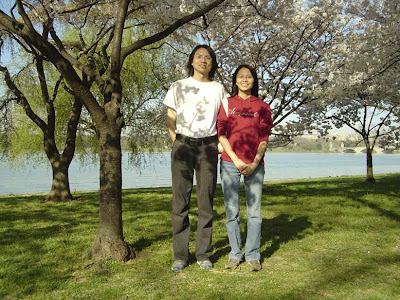
I don't really believe in astrology but sometimes I do believe that an Aries can be impetuous. The day before I returned to Stirling, I told my sister Liwen that it might be a good idea to visit Washington DC for those blooming cherry trees and, above all, buy a souvenir thimble for myself. Both pumped up, spending no time pondering this move, my sister and I took the over-night Greyhound from New York City to Washington DC at 1.30 am and arrived at 5.30 am, just before sunrise.

We were in time for the National Cherry Blossom Festival, an annual celebration from March 31st to April 15th which commemorates the gift of 3,000 cherry trees to Washington DC from Mayor of Tokyo, Ozaki Yukio (尾崎行雄, click here for details of an English translated version of his autobiography), in 1912.

Those cherry trees were presented to enhance the growing friendship between the United States and Japan, in response to which the US government also sent flowering dogwood trees as a gift to the Japanese people in 1915. However, the 'friendship' between the two countries turned sour when Japan was condemned by the US together with the League of Nations, the UK, Australia and the Netherlands, for its attacks against China. Eventually friendship became hostility after a surprise attack on the United States naval base on Pearl Harbor by the 1st Air Fleet of the Imperial Japanese Navy in 1941.

Well, long gone are the days of war. Today over a million people per year come to Washington DC for these cherries in bloom, the harbingers of spring in the capital city.

Liwen and I spent 8 hours walking around the Tidal Basin (satellite image from Google Maps), strolling on streets and avenues and, of course, looking for thimbles. We returned to New York City before sunset.

PosterThis year's poster, created by Phyllis Saroff from Annapolis, Maryland.

10 April 2007

Micro mini umbrella from the US

Mini brolly
I've just been back from a two-week holiday in New York. Apart from reunion with my sister whom I haven't seen for a year, there was a great discovery: not everything in the States is necessarily big.

I suppose most people have the impression that in the US everything is big, extremely big, so unnecessarily big that sometimes we feel we were in Brobdingnag, the land occupied by giants in Jonathan Swift’s Gulliver’s Travels. It seems that the Americans have a penchant for supersizing things. They have offers such as ‘supersize your hamburger or coke for just an extra ¢1’, super-overweight people and therefore clothes in size XnL. But, returning from the holiday, I twigged that not everything in the States is necessarily big.

I brought a tin of M&S shortbread for Marcia as a birthday gift. I also received a ‘wee’ gift from her because, just as in our undergraduate days in Taiwan, she always remembered that my birthday came ten days later after hers and always gave me something unusual that, in her words, fitted my image, for example, duplicated contemporary paintings or sweetcorn facial masks.

This year Marcia gives me a totes umbrella. Obviously, her memory serves her pretty well so that she remembers that I had a brolly with me all the time when I was an undergrad at the National Taiwan University because I commuted between the University and my hometown Keelung, the harbour of rain (read this for more about my childhood memory of rain). However, she apparently has slightly unsatisfactory meteorological knowledge of the weather in the British Isles as she doesn’t realise that I simply can’t hold firmly a brolly when a Scottish gust of wind blows.

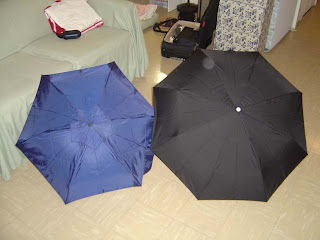
This umbrella, according to the tag, 'folds really small to fit most anywhere' and 'opens full size', but it's indeed so super-small that it hardly sheltered me and Marcia from a sudden shower when we were walking on the campus of Rutgers where she completed her master degree.

Comparison brolly
Look, this umbrella is realy a bit smaller than an ordinary one. Ergo, I can assure you that not everything in the States is necessarily big.

08 April 2007

My first-ever musical experience

King and I
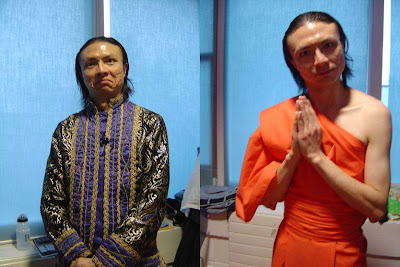
I passed the audition to be accepted into the Stirling and Bridge of Allan Operatic Society last September and was then cast as the Interpreter for its 2007 show The King and I presented at MacRobert Arts Centre from 12th to 17th March, including 3 matinées and 6 evening performances.

I'd done some Chinese operas before I came to Scotland but I had no experience with musicals. It's really my debut on Western musical stage. I took great delight in presenting such a persona although I had only a few lines. In addition to the Interpreter, I also played other walk-on parts, a slave and a priest, and therefore at one point I had to change from one character to another within 30 seconds. It's good fun to run off-satge and on-stage while changing.

In the original script at Act 1 Scene 1 the Interpreter was kicked by the Kralahome (sort of 'Prime Minister, the King's right-hand man) and sent sprawling. However, our director Alan C Jones just wanted a more dramatic effect so the Kralahome was asked to punch my tummy and then kick my bum. Me and Jim Howson, who played the Kralahome, really enjoyed this modification.

As the Interpreter should be kind of middleman who puts on airs and thinks he is an important figure, I just showed a funny expression on my face. This was a successful deed; the audience loved it.

I don't know which show the committee will choose for our 2008 show but I'm sure I will get a part and create a new expression on my face.

04 March 2007

IQ test: Pick the odd one out

An IQ test is a set of problems, usually including items from different domains such as short-term memory, spatial visualisation, perceptual speed and verbal knowledge, designed and used to measure intelligence. So many different forms of IQ tests have been designed and revised since 1905 when a French psychologist, Alfred Binet, together with his colleague Theodore Simon, devised the first intelligence test, the Binet-Simon intelligence scale, in modern times.

There is always criticism that IQ tests may be biased, especially when the same set of questions are used on people from different cultures or of different races.

I'm not particularly interested in seeking evidence produced by any academic research regarding the validity of IQ testing. I still remembered my IQ was 62 according to a test in 1990 and 135 according to another test in 1997. I don't think I could make such progress in seven years' time and thus never believe this issue is worth exploring.

However, if my memory serves me, it seems that there are always 'pick-the-odd-one-out' questions in whatever form of IQ tests. From the following examples, you will understand why these tests are so biased.

Pick the odd one out:
  1. Asphalt, delight, leave and uncle
  2. Sun, moon, earth and lemon
  3. Da Vinci, Einstein, Kennedy and Marco Polo
And the answers:
  1. Asphalt, because it is the only one that cannot form an idiom with a national adjective. (You can have Turkish delight, French leave and Dutch uncle, but can you have XXX asphalt?)
  2. Earth, because when you were a wee boy or girl you usually coloured sun, moon and lemon 'yellow' with your crayon. (Earth is usually coloured blue or sometimes green.)
  3. Einstein, because he is the only one who doesn't have an airport named after him. (Da Vinci serves Rome, JFK serves New York and Marco Polo serves Venice.)
Bloody heck, are we supposed to know these when doing an IQ test if
  1. we've never heard any of these three English idioms?
  2. we've never done any colouring with crayons in childhood?
  3. we've never visited Rome, New York or Venice?

01 March 2007

Advertising song commission

I was commissioned by a friend last year to write an advertising song for his biotechnology company, Springsbio. However, as I had been busy finishing my thesis, I didn't even lay down one note on my Sibelius until Chinese New Year, let alone arrangement and instrumentation.

This friend made a very strange request. The song has to be pentatonic but not too Chinese, easy to sing along but not too clichéd and similar to other existing successful advertising songs but not lacking originality. Goodness gracious, what will it be?

For some years, I've written music for theatre, advertising jingles and arrangement for church hymns and worship songs, but none of my 'patrons' has ever made such challenging specifications. Spending all day Tuesday, I put theories, concepts and his requirements together and carved out this quasi-scherzo, playful tune.

Lighthearted as it sounds, the motive is absolutely heavily serious. He and his colleagues are all satisfied with this short piece. Thanks to this challenging commission, all the symptoms of PSS (post-submission syndrome), which have been making me disoriented since I submitted, were drastically alleviated. Nevertheless, I wonder how this song would match the image of a biotech company.

Come on, give me more exacting musical tasks!